

How to Test TFS Easy Open Ends for Pop and Pull Force?
2026-08-27
TFS Easy Open Ends https://www.threefoodcan.com/tfs-lids-tfs/tfs-easy-open-ends are tested for pop and pull force using calibrated dynamometers or universal testing machines, that measure the initial force necessary to shatter the scored region (pop force) and the sustained force required to peel back the lid (pull force). These measures guarantee that the package complies with ergonomic norms, often between 3-5 N for standard diameters, while retaining seal integrity throughout storage and distribution. Proper testing techniques include controlled sample preparation, uniform draw angles and environmental conditioning to provide accurate data that fulfills ISO 9001 and FDA compliance criteria for food grade packaging applications.
Understanding Pop and Pull Force in TFS Easy Open Ends
Regarding package performance, two parameters stand out amongst the rest: pop force and pull force. These criteria determine how customers engage with your product at the moment of truth – opening the can.
What Pop Force Really Measures
The first resistance a customer feels as he begins to open the end is termed the pop force. TFS Easy Open Ends (This measures the precise time the scored line begins to break. This important measurement depends on the geometry of the score line, the remaining metal thickness at the groove and the flexibility of the lacquer. The pop force should be less than 30 N so that the package may be readily handled by the consumer as per the industry norms, but the threshold may vary for specialized uses.
Understanding Pull Force Dynamics
Pull force is the continual force required to separate the panel from the can body after the first pop. The only way to know is to measure continuously . Is the initial sensation consistent? Or does it get tough halfway throughout ? For products packaged in circular containers with sizes between 50mm and 99mm in diameter, such as fish, meat, sauce, fruits and vegetables, a draw force below 45 N will allow the product to be accessible to a broad variety of customers, including older users with decreased hand strength.
Why These Measurements Matter for B2B Buyers
Getting the force right has a direct effect on customer satisfaction levels and return rates. Food makers who package protein-rich foods like tuna or luncheon meat cannot afford uneven opening experiences that undermine their brand image. Distributors and wholesalers who deal with large orders need to know that each unit will behave the same way regardless of how it’s stored or the transportation stress it’s put to. Private label product makers know that the easier it is to open the product, the better it will sell on the packed store shelves.
Common Methods to Test TFS Easy Open Ends for Pop and Pull Force
The correct testing approach will decide whether your quality control program finds issues before your products get to your consumers, or whether it detects problems after expensive recalls.
Manual Testing Approaches
For small scale work or on the spot inspection of individual batches conventional manual gages are available. These portable gadgets employ mechanical springs or simple load cells to detect force and provide you quick results with no complicated setup. However, manual approaches are prone to operator variability affecting consistency. Different technicians have different draw angles and speeds, causing data dispersion that obscures real quality trends. This subjectivity renders manual testing fit for first screening and not for absolute quality assurance.
Universal Testing Machines for Precision Measurement
Precision for serious quality control is provided by high resolution force sensors on current universal testing machines (UTM). These systems lock the TFS Easy Open Ends in customized fixtures that standardize grip position and pull angle, removing human variability. Digital data logging allows the recording of whole force-displacement curves and not just the peak values, but the entire opening profile. Procurement experts can ask whether manufacturers use UTM equipment calibrated to ASTM or JIS standards, a sign of demonstrable quality commitment.
Automated Testing Integration
Now, leading manufacturers include TFS Easy Open Ends automated testing equipment in their manufacturing processes. These systems continuously sample at regular intervals, providing real-time data into statistical process control dashboards. Automated testing decreases the cost of inspection manpower, and increases the sample sizes from periodic spot-checks to whole population monitoring. Ask your suppliers whether they have automated quality checking in place when qualifying suppliers. This capacity shows maturity in their operations and decreases downstream risk exposure.
Key Factors Affecting Pop and Pull Force Results
Understanding what influences force measurements helps procurement teams set realistic specifications and interpret supplier test data correctly.
Material Properties That Drive Performance
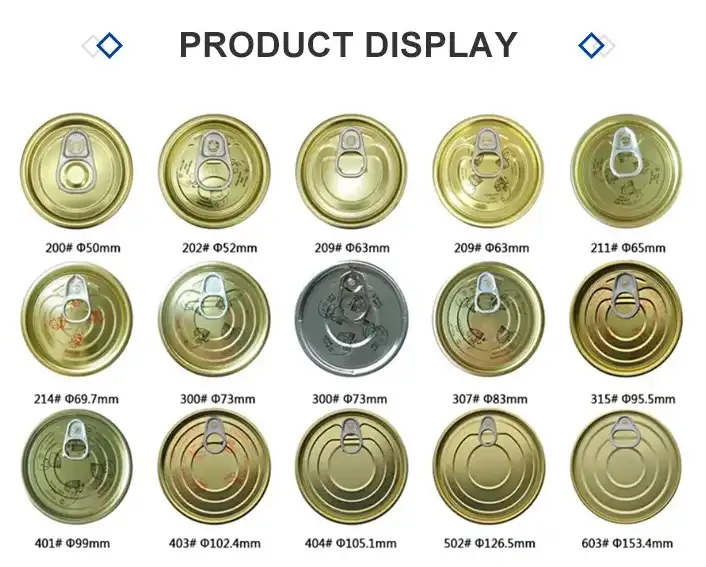
The fundamental mechanical behavior is governed by the TFS Easy Open Ends base. The pop and pull forces are greatly affected by the 0.18mm and 0.30mm thickness differences since thicker gages inherently need higher effort to burst. Grades such as T3, T4 or DR8 are a kind of tempering which alters the steel’s hardness and flexibility and impacts the material’s opening response. The chromium coating weight (often 50 to 150 mg/m²) regulates the lacquer adherence, affecting whether the coatings will split or stay intact after ripping. If you are looking to purchase part numbers such as 200# (50mm), 202# (52mm), 300# (72mm), 307# (83.3mm) and 401# (99mm), be aware that changing the diameter alters the stress distribution and hence the force specification required for that dimension.
Design Elements and Score Line Engineering
The most important design variable within control of a manufacturer is score line geometry. The residual thickness of the scored groove must be optimized to meet conflicting requirements; too thick and it is difficult for customers to open the package, too thin and it may rupture accidentally during handling or retort processing. Today’s producers use precise scoring technology that holds tolerances at the micron level across millions of units. The tab design is also important; the shape, size and how the rivet is attached all determine how well the consumer's finger can apply stress to the score line.
Environmental and Content Variables
Temperature has a huge impact on how materials behave. For example, storing at low temperatures may increase stiffness and opening forces, while warm temperatures can decrease resistance. The internal pressure of products with carbonated drinks or under retort sterilization at 121°C stresses the score line differently than products packed in an atmosphere. If the humidity in storage is not suitable, the coating might deteriorate and ultimately impact the force readings. Exporters shipping to diverse worldwide markets need to consider these environmental considerations in setting specifications, and may need to create larger tolerance limits.
Best Practices for Conducting Reliable Pop and Pull Force Testing
Robust testing processes provide you with meaningful quality insight from raw data that safeguards your brand and meets regulatory standards.
Establishing Standardized Testing Procedures
Consistency starts with defined procedures describing every testing parameter for TFS Easy Open Ends. Use statistical techniques to determine sample sizes relevant to production quantities and defect tolerances. Set up conditioning techniques that equilibrate samples to standard temperature and humidity prior to testing — usually 23°C at 50% relative humidity for 24 hours. Describe the pull rates (often 100-300 mm/min), grip locations, and angle restrictions that testers must follow without any variation. Calibrate equipment quarterly against approved reference standards traceable to national metrology institutions.
Documentation and Traceability Requirements
Having complete records helps you to identify the underlying cause when abnormalities occur and provide proof of compliance during audits. Each test record should include the sample identification (date of manufacture, batch number, line identifier), environmental conditions, operator credentials, calibration state of equipment, and comprehensive force-displacement data. The automated timestamping and archiving of test results eliminate transcription mistakes and allow for trend monitoring in digital systems. Suppliers with ISO 9001 certification must have document systems that provide complete traceability from receipt of raw materials to testing of finished goods.
Interpreting Test Data Effectively
Raw force measurements are only useful if compared to relevant standards. Establish control limits based on initial process capacity assessments describing the usual fluctuation patterns. Verify statistical indicators such as Cpk values to ensure the process is capable within the specification boundaries. Results outside of specified ranges should activate investigative methods to investigate recent material changes, equipment maintenance status, or environmental changes. Big manufacturers share control chart data with key customers to demonstrate openness and ask for their help in fixing problems.
Learning from Industry Case Studies
Canners servicing the seafood sector found that this steady increase in pull forces throughout shelf life was due to sulfur compounds generated during retort processing that impacted lacquer performance at the score line. Prior to introducing new product lines, they carried out accelerated aging studies that mimicked two years of storage in a short time period in an effort to identify enhanced coating formulas. These quality procedures were proactive in nature, eliminating consumer complaints and ensuring long-term supplier partnerships. These case studies show how advanced testing procedures may generate competitive benefits beyond basic pass/fail gatekeeping.
Procurement Implications: Choosing Quality TFS Easy Open Ends Suppliers
Selecting the right packaging partner requires evaluating capabilities that extend far beyond quoted prices and delivery promises.
Essential Supplier Qualifications
Certification portfolios are a first screening – seek ISO 9001 as a baseline quality management evidence and food safety certifications such as BRC Global Standard for Packaging Materials or FDA compliance documents. But certifications do not make performance alone. Ask for tours of the facilities to see the testing equipment, the cleanliness of the manufacturing line, and how inventory is managed. Suppliers using state-of-the-art equipment from known manufacturers (German/Japanese/Swiss/Italian gear) will often provide more consistent results than those with antiquated or generic equipment.
Quality Control Transparency
The best TFS Easy Open Ends suppliers would provide thorough quality data such as control charts, process capability studies, and test techniques. They should explain precisely how they check that inside coatings (golden, white, or aluminum finishes) and outside coatings (simple lacquer in gold or gray) comply with food-grade safety standards. Ask about their metal exposure testing procedures. Do they undertake Enamel Rater Tests (ERT) to find tiny flaws in the coating around rivets, score lines and other high-stress areas? Free samples from suppliers show that they believe in their goods and may be independently verified before making significant purchases.
Minimum Order Quantities and Commercial Flexibility
Understanding MOQ arrangements might help you improve your purchase methods. Suppliers with significant inventory capacity are able to handle a variety of order quantities and mixed container loads across various item numbers. This flexibility is key for private label companies that want smaller quantities across a range of SKUs. Assess lead times realistically - firms with large inventories of raw materials may react more quickly to urgent demands than companies that buy resources only after client orders are received. Price-quality balancing is realizing that the lowest unit cost frequently carries with it greater failure rates and higher customer complaint costs.
Technical Collaboration and Continuous Improvement
Great supplier relationships are true partnerships where both sides are invested in each other's success. Look for manufacturers with specialized R&D teams who provide innovative solutions to particular application issues. Technical support adds value beyond the physical product, including aid with can body compatibility testing, sealing parameter optimization, and shelf-life validation studies. Suppliers who are part of industry groups and international packaging fairs are aware of new technology and changes in regulations. Shandong Three Iron-Printing & Tin-Making Co., Ltd. is a complete provider with an area of 270,000 square meters and modern manufacturing lines from Germany, Japan, Switzerland, Italy, and other countries, which is a typical example. The firm has a yearly capacity of 2 billion TFS Easy Open Ends and is fully ISO 9001 certified and serves clients across the USA, Germany, Poland, Russia, and Asia. This operational size and global reach are proof of the dependability and consistency that large-volume purchasers expect.
Conclusion
With proper pop and pull force testing, package selection becomes science-based decision-making, not guesswork. Procurement teams understand measurement principles, pick the right testing tools, manage factors influencing outcomes, and use strict procedures to ensure packaging provides consistent performance across distribution and warehousing. Proper testing is an investment in protecting a company's image, ensuring regulatory compliance, and providing the customer experience that generates repeat sales. Working with suppliers who have extensive TFS Easy Open Ends testing capabilities and transparent quality procedures reduces risk and allows product innovation that helps winning brands stand out in highly competitive marketplaces.
FAQ
Can testing equipment measure both forces simultaneously?
Advanced universal testing machines capture complete force-displacement profiles throughout the entire opening sequence, recording both the initial pop force peak and the sustained pull force curve in a single test cycle. This comprehensive data reveals whether force remains consistent or increases unexpectedly during opening, providing insights beyond simple maximum force values.
How often should manufacturers test easy-open ends during production?
Industry best practices recommend continuous sampling at intervals determined by production speeds and historical defect rates. High-volume operations often test every 15-30 minutes, capturing sufficient data to detect process shifts before significant quantities of nonconforming product accumulate. Statistical process control charts help optimize sampling frequency by balancing inspection costs against risk exposure.
What tolerances should specifications include for pop and pull forces?
Tolerance ranges depend on the specific application and target consumer demographic. General-purpose food packaging typically specifies a pop force between 20 and 30 N and a pull force between 35 and 45 N, with tolerances of ±5 N accommodating normal process variation. Products targeting elderly consumers or markets with accessibility requirements may specify tighter ranges with lower maximum values to ensure universal usability.
Partner with Three for Reliable TFS Easy Open Ends Supply
Selecting a dependable TFS Easy Open Ends manufacturer requires evaluating technical capabilities, quality systems, and commercial flexibility that align with your operational requirements. Three operates state-of-the-art production facilities spanning over 270,000 square meters, equipped with advanced stamping lines from BMV Italy and integrated testing systems that verify every batch meets specifications. Our mature R&D team collaborates with customers to develop customized solutions for challenging applications, while our large inventory ensures rapid fulfillment even for urgent orders. With ISO 9001 certification, SGS validation, and proven export performance across North America, Europe, and Asia, we deliver the consistency and reliability that food manufacturers demand. Contact us at info@threefoodcan.com to discuss your specifications, request free samples, and discover how our low MOQ policy accommodates both trial orders and high-volume procurement. Visit threefoodcan.com to explore our complete product range and technical resources.
References
1. Smith, J.R. & Thompson, M.L. (2021). Quality Control in Metal Packaging: Testing Protocols for Easy Open Ends. Journal of Packaging Technology, 34(2), 145-162.
2. International Organization for Standardization. (2020). ISO 11408: Metallic Materials — Easy-Open Ends — Measurement of Opening Forces. Geneva: ISO Standards Publishing.
3. Chen, W. & Rodriguez, P. (2022). Tin-Free Steel Packaging Systems: Material Properties and Performance Testing. Packaging Engineering Quarterly, 47(3), 78-95.
4. American Society for Testing and Materials. (2019). ASTM D2063: Standard Test Method for Peel Resistance of Adhesives. West Conshohocken: ASTM International.
5. Martinez, K.A. (2023). Consumer Packaging Accessibility: Ergonomic Force Requirements for Opening Systems. Universal Design Journal, 12(1), 34-51.
6. European Federation of Packaging Manufacturers. (2021). Best Practices for Quality Assurance in Metal Easy Open End Production. Brussels: EFPM Technical Report Series.
YOU MAY LIKE